VF-96
| Fighter Squadron 96 | |
|---|---|
|
VF-96 squadron insignia | |
| Active | 1 June 1962 – 1 December 1975 |
| Country | United States |
| Branch | United States Navy |
| Role | Fighter aircraft |
| Part of | Inactive |
| Nickname(s) | Fighting Falcons |
| Engagements |
Korean War Vietnam War |
| Aircraft flown | |
| Fighter |
F4U-4 Corsair F9F-6 Cougar F-8C Crusader F-4B/J Phantom II |
_insignia_c1970.png)
Fighter Squadron 96, or VF-96 Fighting Falcons was an aviation unit of the United States Navy in service from 1962 to 1975. When assigned to Carrier Air Wing Nine (CVW-9) their tailcode was NG, and their radio callsign was Showtime. Originally established as United States Naval Reserve squadron VF-791 Fighting Falcons on 20 July 1950 it was redesignated VF-142 after becoming a regular squadron on 4 February 1953. It was re-designated VF-96 on 1 June 1962 and disestablished on 1 December 1975.[1]
History

_1954.jpg)
_1960.jpg)
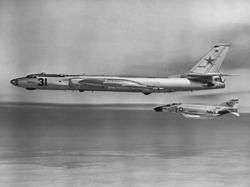
VF-791 was assigned to Carrier Air Group 101 (CVG-101) aboard USS Boxer for a deployment to the Western Pacific and Korea from 2 March to 24 October 1951. During this deployment VF-783 lost 4 F4U-4s.[2]
VF-142 was assigned to Carrier Air Group 14 (CVG-14) aboard the USS Randolph for a Mediterranean deployment from 3 February to 6 August 1954.
VF-142 was assigned to CVG-14 aboard the USS Ranger for a deployment to the Western Pacific from 3 January to 27 July 1959.
VF-142 was assigned to CVG-14 aboard the USS Oriskany for a deployment to the Western Pacific from 14 May to 15 December 1960.
VF-142 was assigned to Carrier Air Group 11 (CVG-11) aboard the USS Kitty Hawk for her voyage around South America from 11 August to 1 November 1961.
VF-96 was assigned to Carrier Air Wing Nine aboard the aircraft carrier USS Ranger (CV-61) for a deployment to the Western Pacific from 9 November 1962 to 14 June 1963.
Vietnam
VF-96 embarked aboard the USS Ranger for a deployment to Vietnam from 5 August 1964 to 6 May 1965.
On 9 April 1965 an F-4B #151425 from VF-96 crashed into the sea following an engine flamout on launch for a 4 plane combat air patrol.[3] Later during the patrol an F-4B piloted by Lieutenant j.g. Terence M. Murphy and his RIO, Ensign Ronald Fegan, shot down a Chinese MiG-17 "Fresco" near Hainan, scoring the F-4 Phantom's first air-to-air victory. The Phantom was then shot down either by another MiG or, as enemy reports later indicated, an AIM-7 Sparrow from one of Murphy's and Fegan's wingmen.[4][5] Murphy and Fegan were listed as killed in action, body not recovered.[6][7]
VF-96 embarked aboard the aircraft carrier USS Enterprise (CVN-65) for a deployment to Vietnam from 26 October 1965 to 21 June 1966.
On 12 February 1967, Lieutenant Commander Martin Sullivan and Lieutenant j.g. Paul Carlson flying F-4B #152219 crashed at sea during intercept training.[8][9]
On 9 May 1968 USAF exchange pilot Captain John Heffernan and his RIO Lieutenant j.g. Frank Schumacher shot down a Vietnam People's Air Force (VPAF) MiG-21 with an AIM-7.[5]:60–62
.jpg)
Several F-4s of VF-96 were destroyed during the USS Enterprise fire on 14 January 1969.
VF-96 embarked aboard the USS America (CV-66) for a deployment to Vietnam from 10 April to 21 December 1970.
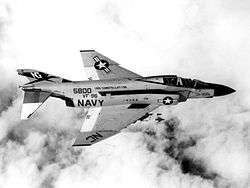
VF-96 embarked aboard the USS Constellation (CV-64) for a deployment to Vietnam from 1 October 1971 to 1 July 1972. During this deployment, on May 10th, Lieutenant Duke Cunningham and Lieutenant j.g. William P. Driscoll of VF-96 scored their aerial victories becoming the only US Navy aces of the war. Three more VPAF MiG-17s were downed by two other VF-96 crews, two by Lieutenant Michael J. Connelly and Lieutenant Thomas J. Blonski and one by Lieutenant Steven C. Shoemaker and Lieutenant j.g. Keith V. Crenshaw.
VF-96 again embarked on the Constellation for its final Vietnam cruise from 5 January to 11 October 1973.
Between June 21 and December 23, 1974 the Fighting Falcons along with sister-squadron VF-92 made its last operational deployment with CVW-9, aboard Constellation, before being disestablished on December 1, 1975.
Home port assignments
Aircraft Assignment
Notable members
See also
- History of the United States Navy
- List of inactive United States Navy aircraft squadrons
- List of United States Navy aircraft squadrons
References
- ↑ "Fighter Squadron Lineage". Naval History and Heritage Command. Retrieved 6 October 2016.
- ↑ Campbell, Douglas (2013). U.S. Navy, U.S. Marine Corps and MATS Aircraft Lost During the Korean War. Lulu.com. p. 155. ISBN 9781304610737.
- ↑ "ASN Wikibase Occurrence # 82586". Aviation Safety Network. Retrieved 21 December 2015.
- ↑ Burgess, Richard (1985). The Naval Aviation Guide, 4th edition. Naval Institute Press. p. 388. ISBN 0870214098.
- 1 2 Elward, Brad (2012). US Navy F-4 Phantom II MiG Killers 1965-70. Osprey Publishing. pp. 7–9. ISBN 9781782006589.
- ↑ "Terence Meredith Murphy". The Virtual Wall. Retrieved 15 July 2012.
- ↑ "ENS Ronald James Fegan". The Virtual Wall. 2012.
- ↑ "LTJG Paul Victor Carlson". The Virtual Wall. Retrieved 21 December 2015.
- ↑ "LCDR Martin Joseph Sullivan". The Virtual Wall. Retrieved 21 December 2015.