Contrastive focus reduplication
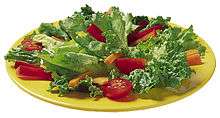
This is a salad-salad, not a tuna salad[1]
Contrastive focus reduplication (also lexical cloning, the double construction) is a type of syntactic reduplication found in some languages that indicates the prototypical meaning of the repeated word or phrase, a form of retronymy. The term word word was coined by U.S. writer Paul Dickson in 1982 to describe this.[2]
The first part of the reduplicant bears contrastive intonational stress.
Examples
The authors of the original article note that a number of examples was collected in a "reduplication corpus"[3] they have gathered:[1]
- SALAD-salad refers to the original meaning of green salad
- AUCKLAND-Auckland refers to the New Zealand city, of all cities with this name
- "I’m up, I’m just not UP–up" — Language Log noticed that this example from the "Contrastive focus reduplication" paper was pinched by Zits. [4]
The poem "After the Funeral"[5] by Billy Collins contains many examples of contrastive focus reduplication.
See also
References
- 1 2 Ghomeshi, Jila; Jackendoff, Ray; Rosen, Nicole; & Russell, Kevin. (2004). Contrastive focus reduplication in English (the salad-salad paper). Natural Language & Linguistic Theory, 22, 307–357
- ↑ The Oxford Companion to the English Language. Oxford University Press. 1992. p. 1127. ISBN 0-19-214183-X.
- ↑ Corpus of English contrastive focus reduplications
- ↑ Contrastive focus reduplication in Zits
- ↑ ""Elusive" and "After the Funeral" by Billy Collins" (PDF). Boulevard Magazine. Archived from the original (PDF) on 2015-01-16. Retrieved 2014-10-26.
- Dray, Nancy. (1987). Doubles and modifiers in English. (Unpublished M.A. thesis, University of Chicago).
- Horn, Laurence. (1993). Economy and redundancy in a dualistic model of natural language. In S. Shore & M. Vilkuna (Eds.), SKY 1993: Yearbook of the Linguistic Association of Finland (pp. 31–72).
- Wierzbicka, Anna. (1991). Cross-cultural pragmatics: The semantics of human interaction. Berlin: Mouton de Gruyter.
This article is issued from Wikipedia - version of the 11/30/2016. The text is available under the Creative Commons Attribution/Share Alike but additional terms may apply for the media files.