Zero divisor
In abstract algebra, an element a of a ring R is called a left zero divisor if there exists a nonzero x such that ax = 0,[1] or equivalently if the map from R to R that sends x to ax is not injective.[2] Similarly, an element a of a ring is called a right zero divisor if there exists a nonzero y such that ya = 0. This is a partial case of divisibility in rings. An element that is a left or a right zero divisor is simply called a zero divisor.[3] An element a that is both a left and a right zero divisor is called a two-sided zero divisor (the nonzero x such that ax = 0 may be different from the nonzero y such that ya = 0). If the ring is commutative, then the left and right zero divisors are the same.
An element of a ring that is not a zero divisor is called regular, or a non-zero-divisor. A zero divisor that is nonzero is called a nonzero zero divisor or a nontrivial zero divisor. If there are no nontrivial zero divisors in R, then R is a domain.
Examples
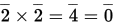
- In the ring , the residue class is a zero divisor since .
- The only zero divisor of the ring of integers is 0.
- A nilpotent element of a nonzero ring is always a two-sided zero divisor.
- An idempotent element of a ring is always a two-sided zero divisor, since .
- Examples of zero divisors in the ring of matrices (over any nonzero ring) are shown here:
- .
- A direct product of two or more nonzero rings always has nonzero zero divisors. For example, in R1 × R2 with each Ri nonzero, (1,0)(0,1) = (0,0), so (1,0) is a zero divisor.








One-sided zero-divisor
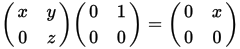
- Consider the ring of (formal) matrices with and . Then and . If , then is a left zero divisor iff is even, since ; and it is a right zero divisor iff is even for similar reasons. If either of is , then it is a two-sided zero-divisor.
- Here is another example of a ring with an element that is a zero divisor on one side only. Let be the set of all sequences of integers . Take for the ring all additive maps from to , with pointwise addition and composition as the ring operations. (That is, our ring is , the endomorphism ring of the additive group .) Three examples of elements of this ring are the right shift , the left shift , and the projection map onto the first factor . All three of these additive maps are not zero, and the composites and are both zero, so is a left zero divisor and is a right zero divisor in the ring of additive maps from to . However, is not a right zero divisor and is not a left zero divisor: the composite is the identity. Note also that is a two-sided zero-divisor since , while is not in any direction.

















Non-examples
- The ring of integers modulo a prime number has no zero divisors other than 0. Since every nonzero element is a unit, this ring is a field.
- More generally, a division ring has no zero divisors except 0.
- A nonzero commutative ring whose only zero divisor is 0 is called an integral domain.
Properties
- In the ring of n-by-n matrices over a field, the left and right zero divisors coincide; they are precisely the singular matrices. In the ring of n-by-n matrices over an integral domain, the zero divisors are precisely the matrices with determinant zero.
- Left or right zero divisors can never be units, because if a is invertible and ax = 0, then 0 = a−10 = a−1ax = x, whereas x must be nonzero.
Zero as a zero divisor
There is no need for a separate convention regarding the case a = 0, because the definition applies also in this case:
- If R is a ring other than the zero ring, then 0 is a (two-sided) zero divisor, because 0 · 1 = 0 and 1 · 0 = 0.
- If R is the zero ring, in which 0 = 1, then 0 is not a zero divisor, because there is no nonzero element that when multiplied by 0 yields 0.
Such properties are needed in order to make the following general statements true:
- In a nonzero commutative ring R, the set of non-zero-divisors is a multiplicative set in R. (This, in turn, is important for the definition of the total quotient ring.) The same is true of the set of non-left-zero-divisors and the set of non-right-zero-divisors in an arbitrary ring, commutative or not.
- In a commutative Noetherian ring R, the set of zero divisors is the union of the associated prime ideals of R.
Some references choose to exclude 0 as a zero divisor by convention, but then they must introduce exceptions in the two general statements just made.
Zero divisor on a module
Let R be a commutative ring, let M be an R-module, and let a be an element of R. One says that a is M-regular if the multiplication by a map is injective, and that a is a zero divisor on M otherwise.[4] The set of M-regular elements is a multiplicative set in R.[5]

Specializing the definitions of "M-regular" and "zero divisor on M" to the case M = R recovers the definitions of "regular" and "zero divisor" given earlier in this article.
See also
- Zero-product property
- Glossary of commutative algebra (Exact zero divisor)
Notes
- ↑ See Bourbaki, p. 98.
- ↑ Since the map is not injective, we have ax = ay, in which x differs from y, and thus a(x-y) = 0.
- ↑ See Lanski (2005).
- ↑ Matsumura, p. 12
- ↑ Matsumura, p. 12
References
- N. Bourbaki (1989), Algebra I, Chapters 1–3, Springer-Verlag.
- Hazewinkel, Michiel, ed. (2001), "Zero divisor", Encyclopedia of Mathematics, Springer, ISBN 978-1-55608-010-4
- Michiel Hazewinkel; Nadiya Gubareni; Nadezhda Mikhaĭlovna Gubareni; Vladimir V. Kirichenko. (2004), Algebras, rings and modules, Vol. 1, Springer, ISBN 1-4020-2690-0
- Charles Lanski (2005), Concepts in Abstract Algebra, American Mathematical Soc., p. 342
- Hideyuki Matsumura (1980), Commutative algebra, 2nd edition, The Benjamin/Cummings Publishing Company, Inc.
- Weisstein, Eric W. "Zero Divisor". MathWorld.