O-hook
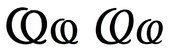
O-hook (Ҩ ҩ; italics: Ҩ ҩ) is a letter of the Cyrillic script. In the Unicode text-encoding standard, this letter is called "Abkhasian Ha".[1] Its form bears some similarities to the Greek letter Theta (Θ θ/ϑ). In English, O-hook is commonly romanized using the Latin letter O with dot below (Ọ ọ) but its ISO 9 transliteration is the Latin letter O with grave accent (Ò ò).
O-hook is used in the alphabet of the Abkhaz language where it represents the labial-palatal approximant /ɥ/, the sound of ⟨u⟩ in French "huit". It is placed between O and Π in the alphabet.
Computing codes
| Character | Ҩ | ҩ | ||
|---|---|---|---|---|
| Unicode name | CYRILLIC CAPITAL LETTER ABKHASIAN HA | CYRILLIC SMALL LETTER ABKHASIAN HA | ||
| Encodings | decimal | hex | decimal | hex |
| Unicode | 1192 | U+04A8 | 1193 | U+04A9 |
| UTF-8 | 210 168 | D2 A8 | 210 169 | D2 A9 |
| Numeric character reference | Ҩ | Ҩ | ҩ | ҩ |
- In Unicode version 1.0, the letters were called CYRILLIC CAPITAL/SMALL LETTER O HOOK.
References
- ↑ "Cyrillic: Range: 0400–04FF" (PDF). The Unicode Standard, Version 6.0. 2010. p. 42. Retrieved 2011-05-13.
Further reading
- Daniels, Peter D. The World's Writing Systems. Oxford University Press, 1996.
This article is issued from Wikipedia - version of the 11/15/2016. The text is available under the Creative Commons Attribution/Share Alike but additional terms may apply for the media files.