Canae
Coordinates: 39°2′N 26°48′E / 39.033°N 26.800°E
| Canae Κάναι | |
|---|---|
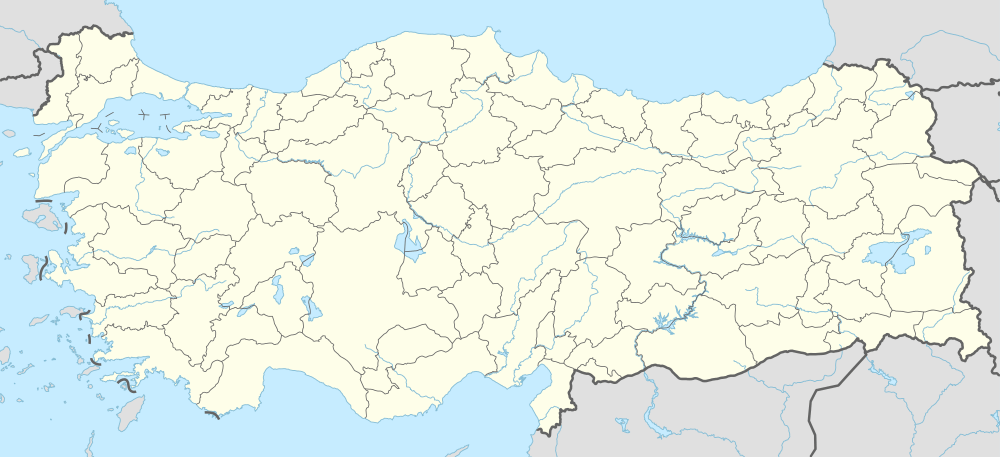  Location within Turkey | |
| Place in the Roman world | |
| Province | Asia |
| Nearby water | Aegean Sea (Dikili Gulf) |
| Events | Battle of Arginusae |
| Location | |
| Coordinates | 39°2′19″N 26°48′53″E / 39.03861°N 26.81472°E |
| Place name | Kane Promontory (Cane) |
| Town | Bademli |
| County | İzmir |
| State | Dikili District |
| Country | Turkey |
| Site notes | |
| Discovery year | 2015 |
Canae /ˈkeɪ.niː/ (Ancient Greek: Κάναι; Turkish: Kane) was, in classical antiquity, a city on the island of Argennusa in the Aegean Sea off the modern Dikili Peninsula on the coast of modern-day Turkey, near the modern village of Bademli.[1][2] Today Argennusa has joined the mainland as the Kane Promontory off the Dikili Peninsula. Canae is famous as the site of the Battle of Arginusae in 406 B.C.[1][3][4]
Canae is mentioned by the ancient writers Herodotus, Strabo, Pliny, Livy, Ptolemy, Sappho, Thucydides, and Mela.[5][6]
History
According to the first-century Greek geographer Strabo, Canae was founded by Locrians coming from Cynus in eastern Greece.[5][7] Canae was built on the island of Argennusa (also spelt Arginusa), beside a small promontory hill variously called Mount Cane /ˈkeɪ.niː/ (Ancient Greek: Κάνη), Aega /ˈiːɡə/ (Αἰγᾶ), or Argennon /ɑːrˈdʒɛnən/ (Ἄργεννον).[5][7][8] The name Canae (Κάναι) means "(city) of Mount Cane"; the district that included Argennusa and the neighboring two islands of Garip and Kalem was called Canaea.[5]
According to the 5th-century B.C. Greek historian Herodotus, the massive Achaemenid army of Xerxes I passed Mount Cane on its way from Sardis to the Battle of Thermopylae in 480 B.C.[5][9][10]
During the Peloponnesian War, an Athenian fleet commanded by eight strategoi unexpectedly defeated a Spartan fleet under Callicratidas off the coast of Canae in 406 B.C. in the Battle of Arginusae.[6]
During the Roman–Seleucid War, fought between the Roman Republic and Antiochus the Great in 192–188 B.C., the Roman navy wintered in Canae on their way to Chios.[5] Livy writes that "the ships were hauled on shore and surrounded with a trench and rampart."[11]
By the time of Pliny the Elder in the first century A.D., the city was deserted.[5][12]
See also
References
- 1 2 Goldhill, Olivia (November 16, 2015). "Researchers just unearthed a lost island in the Aegean". Quartz. İzmir. Retrieved November 21, 2015.
- ↑ Hamel, Debra (May 21, 2015). The Battle of Arginusae: Victory at Sea and Its Tragic Aftermath in the Final Years of the Peloponnesian War. U.S.A.: Johns Hopkins University Press. p. 48. ISBN 978-1-4214-1680-9.
- ↑ "Lost ancient island found in the Aegean". Hurriyet Daily News. İzmir. Retrieved November 14, 2015.
- ↑ Crew, Bec (November 20, 2015). "An entire ancient island has been rediscovered in the Aegean: Have we finally found the long-lost city of Kane?". Science Alert. İzmir. Retrieved November 21, 2015.
- 1 2 3 4 5 6 7 Long, George (1878). "Canae". In William Smith. A Dictionary of Greek and Roman Geography. I. London: John Murray.
- 1 2 Long, George (1878). "Arginusae". In William Smith. A Dictionary of Greek and Roman Geography. I. London: John Murray.
- 1 2 Strabo (1903). The Geography of Strabo. II. Translated by H. C. Hamilton and W. Falconer. London: George Bell & Sons. p. 388.
- ↑ Stephanus of Byzantium, Ethnica
- ↑ Herodotus, Histories 7.42
- ↑ Barkworth, 1993. The Organization of Xerxes' Army. Iranica Antiqua Vol. 27, pp. 149–167
- ↑ Livy, Foundation of the City 36.45, 37.8
- ↑ Pliny, Natural History 5.30
Classical sources
- Herodotus, The Histories
- Livy, The Foundation of the City
- Pliny the Elder, The Natural History
- Pomponius Mela, De situ orbis
- Ptolemy, Geography
- Sappho, quoted in Strabo (below)
- Stephanus of Byzantium, Ethnica
- Strabo, Geography
- Thucydides, History of the Peloponnesian War
External links
| |||||||||||||||||||||||||||||||||||||||||
| |||||||||||||||||||||||||||||||||||||||||
| |||||||||||||||||||||||||||||||||||||||||
| |||||||||||||||||||||||||||||||||||||||||
| |||||||||||||||||||||||||||||||||||||||||
| |||||||||||||||||||||||||||||||||||||||||

